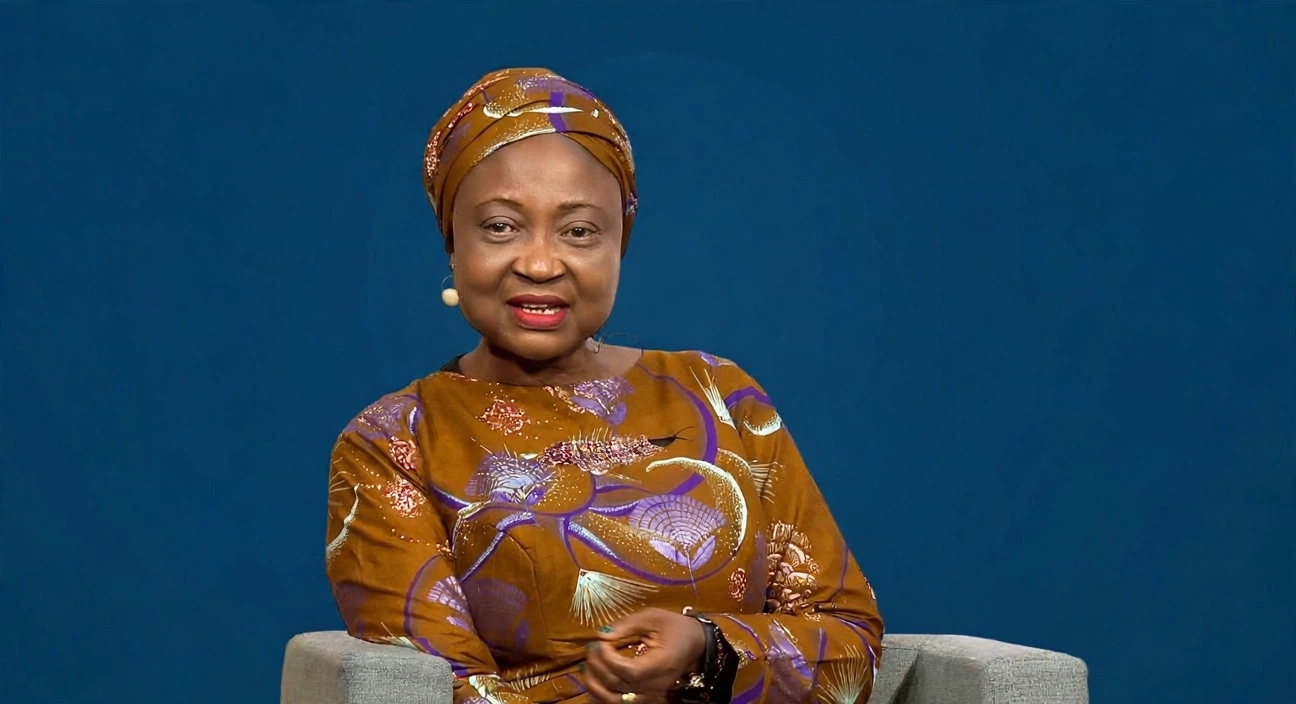
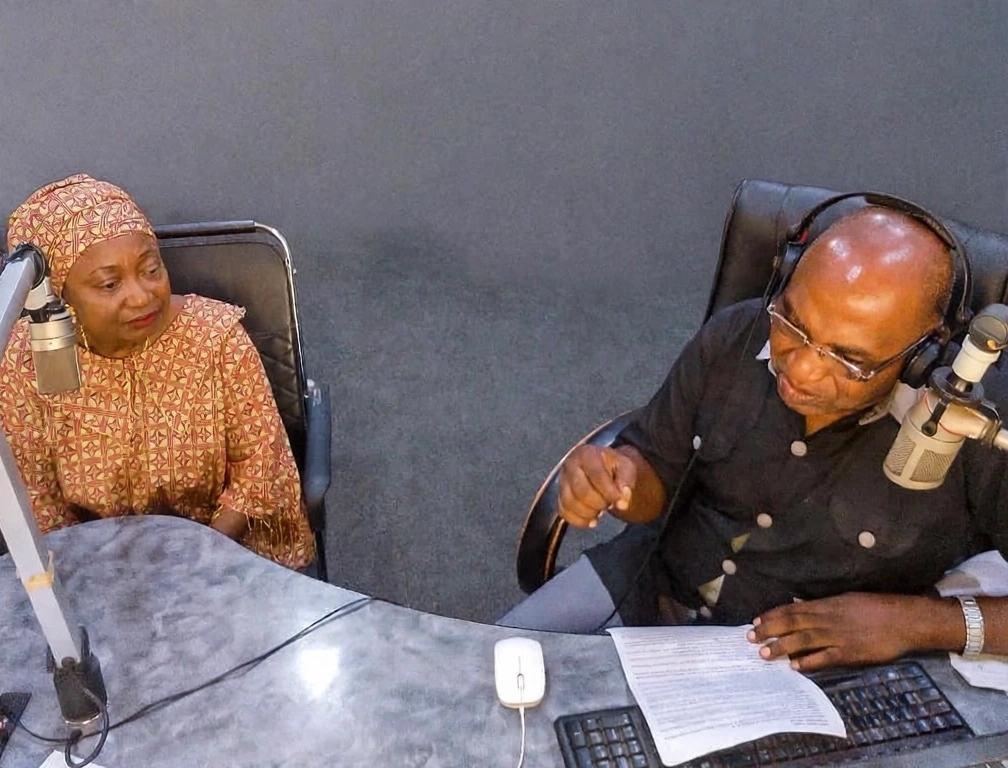
 In this exclusive Migrationwatch Live encounter on AFR 107.7 FM, Ambassador Catherine Udida, MNI, Director, Migrant Affairs at the National Commission for Refugees, Migrants and Internally Displaced Persons (NCFRMI), clarifies the mandate of the Commission as the coordinating agency responsible for all migration-related issues in the country.
Speaking with The Migration Enthusiast, Onoja Saint Michael, Amb. Udida stressed that migration is a human right and a natural human phenomenon, as people will always move in search of education, jobs and greener pastures. However, she cautioned Nigerians against irregular migration, urging them to seek the right information and use regular pathways.
She revealed NCFRMI’s role in protection, reception and reintegration of all categories of returnees without discrimination, noting that home remains home.
In a viral pidgin message to parents and youths, she warned: “Life better pass plenty wealth. Abroad no good like that, but if you want make them go, make you ask question.”
FULL INTERVIEW WITH AMBASSADOR CATHERINE UDIDA, mni
INTRODUCTION
Migrationwatch:
Thank you for remaining a part of this progr am. It’s always a great delight to have you. Ladies and gentlemen, welcome to Migration Desk, a special segment of Migrationwatch Live where we engage key stakeholders and policy makers in the migration sector.
Today, we are particularly honored to have a distinguished personality who functions actively and very visibly at the heart of migration governance in Nigeria. In short, I call her the mother of migration governance. She is Ambassador Catherine Udida, mni, Director Migrant Affairs at National Commission for Refugees Migrants and Internally Displaced Persons, NCFRMI. Your Excellency, we welcome you with delight and thank you for coming.
Amb. Catherine Udida:
Thank you very much and thanks for having me. I use this opportunity to thank the Armed Forces for their service to the country. Thank you.
Migrationwatch:
We also join you to say thank you to Armed Forces Radio. If we are doing migration and we are somewhere else, I know that it won’t be complete because everything that has to do with migration also has links with Armed Forces Radio. That’s why we join Her Excellency to say thank you to management of Armed Forces Radio for the opportunity of this great platform.
ON WHO IS AMBASSADOR CATHERINE UDIDA
Migrationwatch:
Ma’am, please, who is Ambassador Catherine Udida?
Amb. Udida:
My name is Ambassador Catherine Udida, mni. I’m Director Migrant Affairs at the National Commission for Refugees Migrants and Internally Displac ed Persons, NCFRMI.
ON WHAT IS NCFRMI – HISTORY AND MANDATE
Migrationwatch:
Some Nigerians are hearing this for the first time. Many Nigerians are not very familiar with issues about migration. Nigerians only know migration as Japa. With your presence here we are going to debunk all that. Please, what is NCFRMI, what is the history, what is the mandate particularly as relates to migration and migrants in Nigeria?
Amb. Udida:
Thank you very much. NCFRMI is a coordinating agency responsible for all migration related issues in the country. We started off as National Commission for Refugees in August of 1989 and then by 2009 we were given mandates on migration and internally displaced persons. So generally we coordinate all migration related issues in the country with all the stakeholders.
ON THE NEW NATIONAL MIGRATION POLICY
Migrationwatch:
At an event attended by Migrationwatch, you announced that the national migration policy has been renewed and approved. What are the major differences between the old and the new national migration policies?
Amb. Udida:
In 2015 we had the first national migration policy adopted by the Federal Executive Council. Because of emerging issues, trends regionally, globally and even within the country, it became necessary to review. Besides, it was already more than five years. So we decided to review to include all emerging issues including climate-induced displacement and emerging patterns of migration that were not there before. That is the reason we had to review and incorporate all new elements that were not there in the 2015 policy.
ON COORDINATION OF STAKEHOLDERS
Migrationwatch:
NCFRMI coordinates all stakeholders. Let me attempt to name them: Nigeria Immigration Service, Labour, Customs, NAPTIP, NiDCOM, NACTAL, etc. If you coordinate all of them, how easy is it? Including Federal Ministry of Foreign Affairs and Humanitarian Affairs, how possible is it for NCFRMI to coordinate all these agencies?
Amb. Udida:
Nigeria has a very comprehensive and holistic migration governance structure. In line with the migration governance structure, we have four levels. The National Consultative Forum which we are secretariat, the Technical Working Group which is the brain of migration management, and the Thematic Groups comprising stakeholders who are lead agencies.
You have Labour Migration led by Ministry of Labour, Diaspora Engagement led by NiDCOM, Data Management led by National Bureau of Statistics and National Population Commission, and Integrated Border Management in the new policy co-led by NIS and NAPTIP. And my Commission leads Forced Return, Readmission and Reintegration. We coordinate and have meetings periodically, so it’s very easy, it’s holistic, it just works.
ON FUNDING
Migrationwatch: Considering the magnitude of your mandate, how do you get funding? Are you purely government funded?
Amb. Udida:
We get funding from budgetary allocations. Largely most of the things we do is from budgetary allocations. But from time to time we get support from international partners including IOM and local actors like ActionAid, NACTAL, CSOs. Like I said, it’s all-of-government, all-of-society approach, so we are able to manage.
ON INVOLVEMENT OF STATES
Migrationwatch:
What is the involvement of states in migration governance?
Amb. Udida:
The good thing about this review is because there were emerging issues. This new 2025 National Migration Policy incorporated the fourth level which is sub-national level. At sub-national level we work with state governments and we have reintegration committees in about eight locations capturing contiguous states. So we work very closely with state governments even at local government areas.
Migrationwatch:
Is Kogi State part of it?
Amb. Udida:
Kogi is a very active member of the central reintegration committee.
ON WHY YOUTHS STILL TAKE IRREGULAR ROUTES
Migrationwatch:
We have had several campaigns against irregular migration. On the news today, 12 died, 15 died through the Mediterranean. Why do people continue to go through that route when we have stressed the dangers?
Amb. Udida:
For young people, adventure is one of them. And like I keep saying, migration is a human right, so people will naturally want to move. People move for greener pastures, for education, for jobs, and there is also peer pressure, even from family members. The most important reason why people move is lack of awareness. People don’t get to know what they are going to meet and so they only hear that the grass is greener on the other side, there is gold on the streets of Europe, which is not usually the case.
Migrationwatch:
Some have discovered there is no gold on the streets of Europe. We had Jerry on this program who tried many times to get to Europe, spent 7 days on the path to Libya, spent 2 years there, and when he finally got into the boat, he was among the 37 that was recovered and came home through IOM and your organization. We have told the story, yet some are still going. Can’t we look for green pastures within Nigeria?
Amb. Udida:
Of course it’s possible. I like to talk to our youth. There’s nothing wrong with trying to go out and get something better, but it’s not worth the life. It’s not worth your life at all. I just advise that we should be patient and keep hoping, look for things that are good and then get the right information to go abroad. Nobody says you should not go, just go the regular way.
ON COLLABORATION WITH DIPLOMATIC MISSIONS
Migrationwatch:
If a Nigerian has issues in Canada, how does NCFRMI coordinate with the embassy to help?
Amb. Udida:
One of the thematic leaders is Diaspora Engagement, NiDCOM. They are the ones mobilizing Nigerians abroad. They coordinate and report to us. Most importantly, the supervising ministry of NiDCOM is the Ministry of Foreign Affairs, and Foreign Affairs has missions in about 111 countries. So usually we engage with NiDCOM directly and the Ministry directly, and the Ministry interfaces with embassies abroad. So when people are in trouble we get to know and when it’s time for returns, we have advance information and we wait and receive them.
ON RETURN, REINTEGRATION AND ASSISTANCE – WHAT DO RETURNEES GET?
Migrationwatch:
What is it that Nigerians who return get from NCFRMI in terms of reintegration support and what qualifies them?
Amb. Udida:
The qualification you have is that you are a returnee. You come home, usually we wait for you at airports or land borders. When we come in we profile you, assess your psychosocial status, assess your vulnerability. So we now decide what should be the best reintegration package for you.
Immediately you come, apart from hot meal, drinks and change of clothing – some people come with just what they have on – we have clothing, dignity pack for women, for children, pampers, diapers, all of those things. We call it the welcome pack – gives you basic needs, toothpaste, toothbrush, wrappers. Usually from my experience immediately Nigerians arrive and we give them that, it’s like oh we are welcome. Even those angry not wanting to return, we tell them we are happy to have you back.
Thereafter, in collaboration with SMEDAN, ITF, NDE, international partners like GIZ, ICMPD, our dependable partner IOM, there is always reintegration support. We do skills training, give them starter packs after training, and then we follow through to their different states. When we had South African returns, we were very lucky, most state governments keyed in – some states gave financial support, some gave skills training.
ON WHETHER SUPPORT IS AN INCENTIVE FOR IRREGULAR MIGRATION
Migrationwatch:
Would you think that welcome packs and skills is an incentive for some persons to go through irregular migration?
Amb. Udida:
That’s what we’ve started doing in line with new migration policy. We have what we call community engagement. We don’t want it to become a pull factor. So where we call areas of high return, we provide infrastructure in schools, do skills training, we have those we call potential migrants. So we have some people who haven’t gone abroad at all but who are now trained so it doesn’t become a way to entice people to leave. Besides, when you have gone through Libya, you will be in trouble, you don’t want to go back.
ON CRIMINALS/DEPORTEES – ARE THEY ALSO CONSIDERED RETURNEES?
Migrationwatch:
Some get involved with drugs, don’t follow immigration rules and are deported. Are these people part of those we treat as returnees?
Amb. Udida:
You heard me when I said we are in charge of forced returns, readmission and reintegration. A Nigerian that returns is accepted. We can come back home, we do not discriminate. If the person is a forced return, we are a protection agency, we protect everybody that has returned, we don’t discriminate.
ON STATISTICS AND DATA OF RETURNEES
Migrationwatch:
Do you have statistics, database of returning migrants?
Amb. Udida:
Yes, we know for past three years we’ve done more than 30,000 returns. This year alone we have 13,472 Nigerians, besides those who have just returned from Libya. And we keep having more. Data is stored – migration data is stored in National Population Commission while NBS is the voice of Nigeria, they pop the data. So we do have data.
ON WHY AVALANCHE OF RETURNS
Migrationwatch:
What could explain this avalanche of returns?
Amb. Udida:
Home is home. No matter southeast or west, home is home. If you go to a place and it doesn’t work out, you come back home, because you can be rejected anywhere else but you can’t be rejected in your home. It’s a personal decision. Most of them voluntary – like Libya, the situation is horrible there, so why keep staying when your life is at risk? So people are coming back home more and more and we are trying our best to reintegrate.
ON PARTNERSHIP WITH IOM, CIVIL SOCIETY AND OTHER ORGANIZATIONS
Migrationwatch:
What other reasons are the important reasons why you have relationship with organizations like IOM, civil society organizations, NAPTIP, NACTAL? Is it for efficiency or shortage of staff or why do you relate with them? What’s the importance of your partnership with these organizations?
Amb. Udida:
Migration is a multi-sectoral issue and so we also adopt a whole-of-government and whole-of-society approach. So involving all international partners, they collaborate with us to do the job but we are at the front desk, we drive the process and so they support where they can.
ON OPPORTUNITIES FOR CREDIBLE MEDIA LIKE MIGRATIONWATCH LIVE
Migrationwatch:
What opportunities exist for Migrationwatch Live and other credible media who have put upon themselves the mandate of reaching out to Nigerians for necessary awareness creation? What opportunities exist for us to relate with NCFRMI and other stakeholders of migration?⁰
Amb. Udida:
You know the media just like the private sector they are all members of the Technical Working Group because of the importance we attach to the job of awareness creation. Like I said, a lot of people go out not knowing where they are going. And so with this collaboration that we have with you and other media houses we expect that that news will go out and so we are able to now let the youth know that please if you must go out do it the right way.
Migrationwatch:
Listeners, did you hear that? Did you take note? Migrationwatch is now qa member, you just heard Madam saying member of the Technical Working Group of the Migration Framework in Nigeria.
ON SELF-ASSESSMENT OF NCFRMI’S MIGRATION MANDATE
Migrationwatch:
They are telling me time is up but please score yourself as Director Migrant Affairs, how have you fared?
Amb. Udida:
We fared very well. We have a lot that we’ve done within the space, my Commissioner, the Honourable Federal Commissioner Dr. Tijani Aliyu Ahmed, since he came on board we have done a lot. So the migration Rabat process, we became the chair, we reviewed the national policy, we were very active in the International Migration Review Forum, we have introduced a sub-national level where we are already cascading down, we have a pilot in Lagos, in Kano and of course in Abia. So there’s been a lot we’ve done, there is still more to be done but so far so good.
FINAL WORD TO NIGERIAN YOUTH & PARENTS – IN PIDGIN & MOTHER TONGUE
Migrationwatch:
You are not going to speak English, you are not going to speak grammar anymore. In your final words to Nigerian youth, for instance imagine that a family has issues as most people have economic issues and they want their children to travel to save them. Please speak to them first in Pidgin language then second in any language of your choice.
Amb. Udida:
(In Pidgin English):
Una good morning. Oh my papa them, my mama them abeg, make una make no say life better pass, plenty wealth oh. Make una no push una children say because Joe go abroad he don buy, build house, Mary go abroad she don build house, don buy car, say ah ah you Michael why you never go abroad. Please abroad no good oh like that. But if you want make them go abroad make you ask question so that they go know the way they go take go abroad. We no say make them no go, only say make them no go die, make them no lose, make their pikin no go fish in with tears.
Migrationwatch:
Thank you very much Your Excellency, we are grateful to have you. And I’m sure Nigeria, if you’re listening, we keep our words to bring her here, it is an indication that we are the pacesetter of migration reporters and her presence here is a great honor.
Migrationwatch:
Your Excellency, thank you so much for coming. Thank you for the grammar in Pidgin language.
Amb. Udida:
Thank you for having me.
Migrationwatch:
Another time we will have another good guest that will delight you more, until next week Tuesday I and the team you have a great day, we’ll see you by this time next week Tuesday. Have a great day.