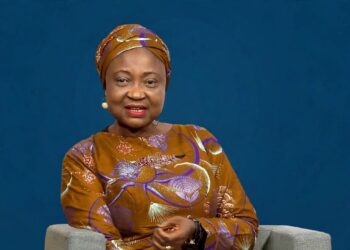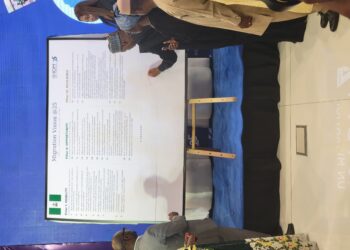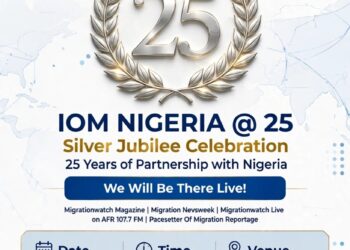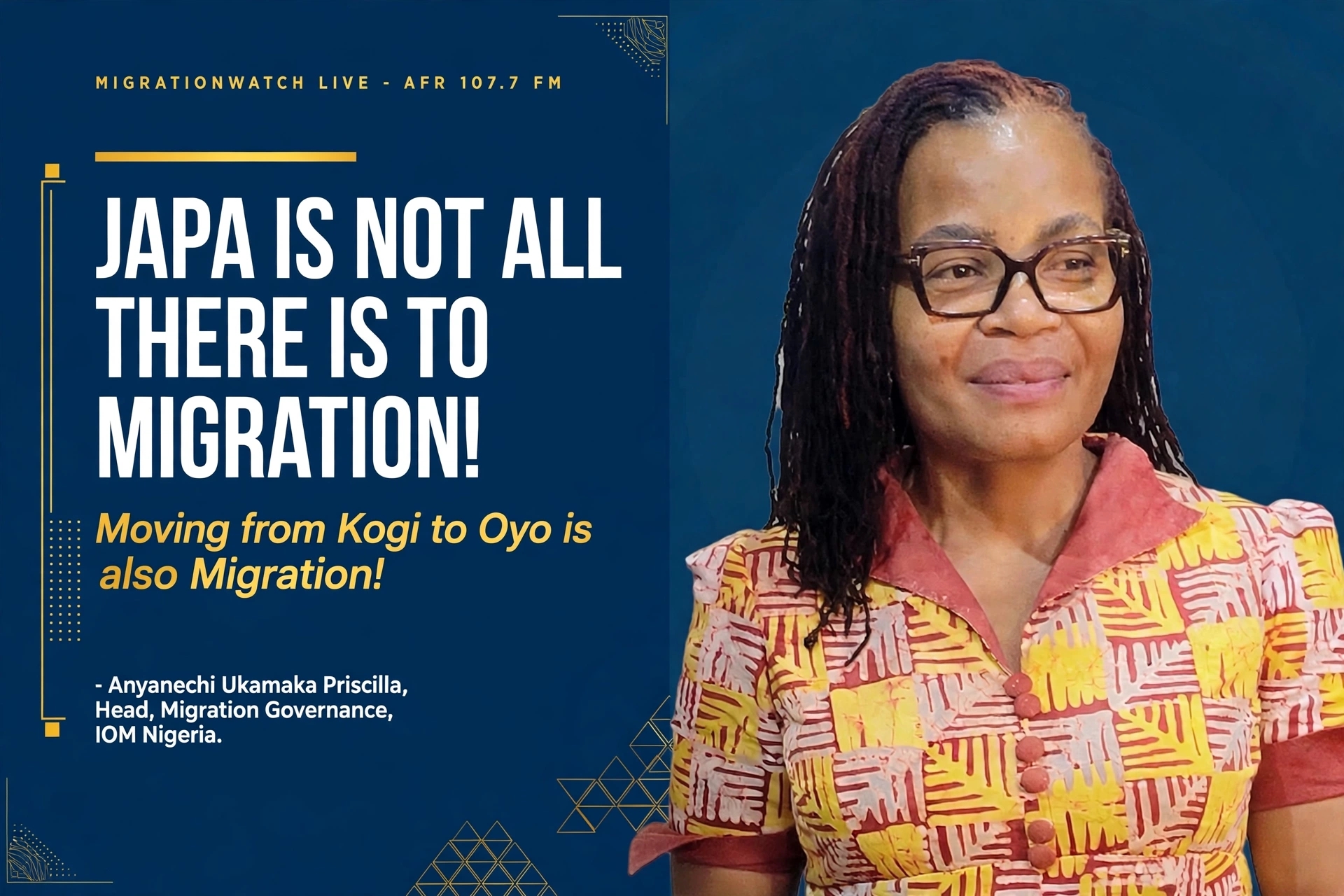
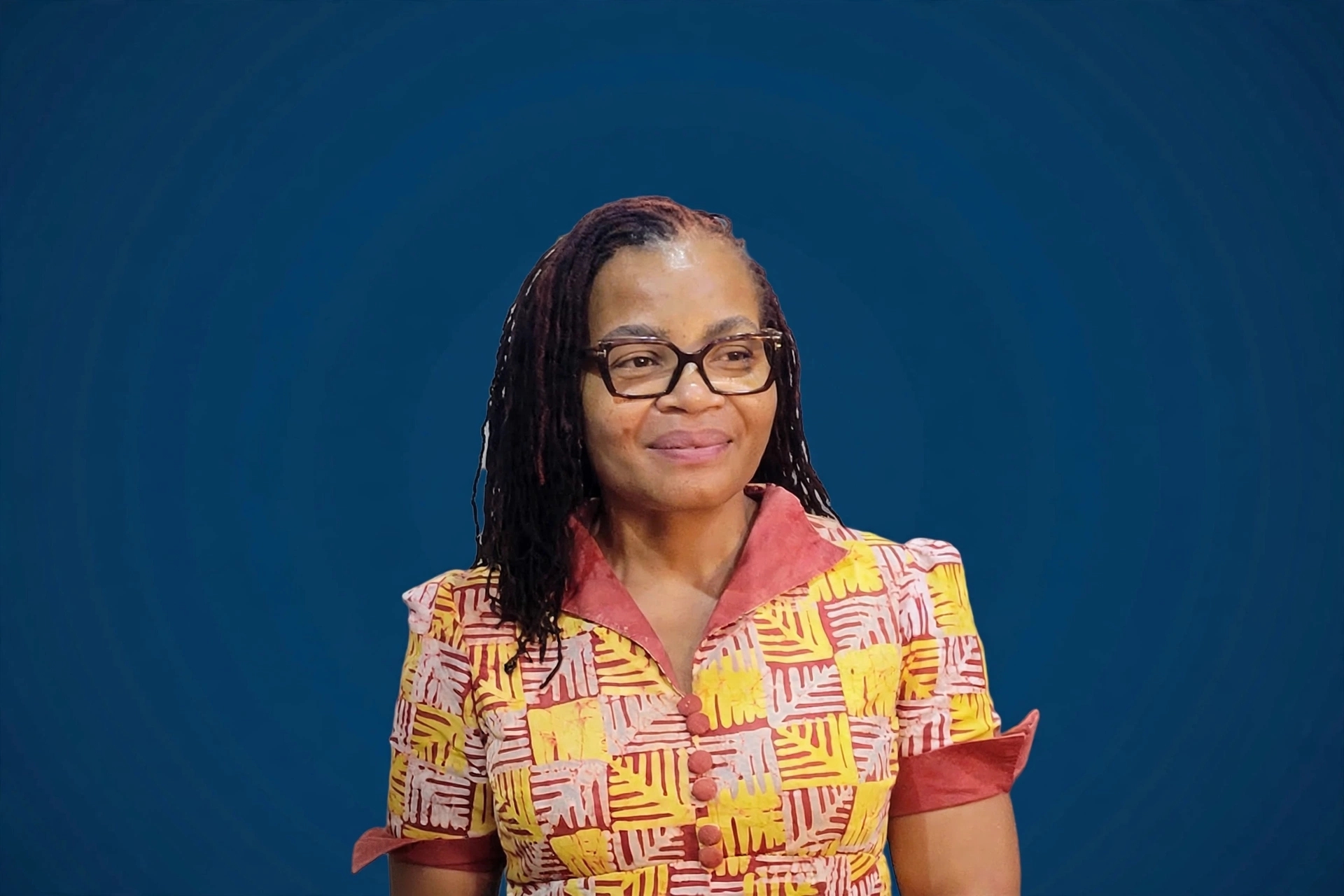
 In Episode 2 of Migrationwatch Live on AFR 107.7 FM, Host Onoja Saint Michael – The Migration Enthusiast sits down with Anyanechi Ukamaka Priscilla, Head, Migration Governance, IOM Nigeria, to demystify migration for every Nigerian.
Is Migration all about Japa? Who really controls migration in Nigeria? Why does IOM care? And what is Safe, Orderly, Regular and Dignified Japa?
She answers all – in simple language every Nigerian can understand. The episode offered listeners a clearer understanding of migration beyond the popular idea of “Japa” and emphasised the importance of informed decisions, lawful pathways and human dignity throughout the migration process.
Read the full explosive interview inside this edition.
MIGRATIONWATCH LIVE
AFR 107.7 FM
EPISODE 2
Host:
Onoja Saint Michael – The Migration Enthusiast
Guest:
Anyanechi Ukamaka Priscilla, Head, Migration Governance, IOM Nigeria
ON WHAT IS MIGRATION – IS IT ALL ABOUT JAPA?
Onoja Saint Michael:
Welcome to Migration Desk on Migrationwatch Live. Many Nigerians do not know very much about migration other than if you hear migration what is synonymous with migration is Japa. Is migration all about Japa? Please let us give a background that will educate our people. What is migration in simple language as if you are speaking to someone out there?
Anyanechi Ukamaka Priscilla:
Okay, migration simply put is the movement of people from one place to the other and the reasons behind this movement can be quite varied. People move for study purposes, people move to seek better employment opportunities, people move for their safety due to several reasons – insecurity, climate change related challenges and generally for the pursuit of better opportunities.
It’s also important to mention that migration does not necessarily mean leaving your own country. For example, someone who moves from Lagos to Kano, that is migration, that person has migrated. However, when movement is across national borders, that is when we have international migration and that is Japa as we know it here in Nigeria. But migration simply speaking is movement, human mobility from point A to point B.
Onoja:
For the first time I’m hearing and I’m sure a lot of people listening are hearing for the first time that if I move from Kogi State to Oyo State I have migrated. So I can say I Japa’d from Kogi to Oyo. Migration matter deep. So who controls migration in Nigeria? Is it IOM?
ON WHO CONTROLS MIGRATION IN NIGERIA
Anyanechi Ukamaka:
Not at all. Migration is quite an interesting subject. When we speak about migration governance, it is really a whole-of-government responsibility. You can’t find one single institution that you would say is responsible for controlling migration.
When it comes to Nigeria for example, we have different agencies that are the lead Ministries, Departments and Agencies of government that are at the lead when the issues of migration governance is being addressed. This would include the National Commission for Refugees, Migrants and Internally Displaced Persons (NCFRMI), Nigerian Immigration Service, Ministry of Foreign Affairs, Ministry of Interior, Ministry of Justice, among others.
IOM’s role when it comes to migration in Nigeria is to provide technical support to Nigeria the same as we do with other countries that are member states to our organization. So there is no single agency. The approach is a whole-of-government approach because there are several MDAs whose mandate relates to issues around human mobility.
ON WHY IOM INTERVENES IN NIGERIA’S MIGRATION ISSUES
Onoja:
I know that IOM is not a Nigerian agency and is not one of the MDAs. Why do you bother to intervene in matters that ordinarily should be problem of Nigeria? If I move from here to Ghana and I have issues, why should IOM care? Why does IOM put themselves into this whole thing and call themselves technical partner?
Anyanechi Ukamaka:
This is a very important question. I will start by saying that IOM is the United Nations Migration Agency and we work with governments around the world at their request and in support of their priorities. So IOM does not engage because IOM wants to engage or is a busybody.
The governments that we work with are IOM member states. These are governments that have aligned themselves with the mandate and as I mentioned, IOM is the UN migration agency.
Statistically in Nigeria, our role is not to take over the responsibility of government. Nigeria determines migration priorities for herself, while IOM provides technical expertise, international experience and support where needed.
It’s also important to know that migration can also happen across borders, so international cooperation becomes essential. What happens along the migratory route may involve several countries and this by the very nature of that movement makes it important for cooperation to happen between governments and in some instances international partners like IOM that have a mandate around the issues that may arise.
So fundamentally our role is to support Nigeria in achieving its own migration governance objectives.
ON ASSISTED RETURNS – 70,000 NIGERIANS SINCE 2017
Onoja:
We heard from the news that IOM assisted more than 70,000 Nigerians to return since 2017. Only last week we received another 174 males from outside the country. What leads to all of this? Why are they coming back? Why did they leave the country? If they left without telling Nigeria or telling IOM, why can’t they return on their own?
Anyanechi Ukamaka:
There is no one single reason why people migrate. People migrate for various reasons – people migrate to seek employment, people migrate for education, people migrate to attempt to reunite with family members, people migrate because they are seeking for safer environment and better opportunities and many other reasons.
However, the difficulty arises when people find themselves in vulnerable situations during their migratory journey. Some of them become stranded, others experience different forms of exploitation like trafficking, some are exposed to labour exploitation, some are exposed to torture, abuse and serious hardship and in such situations they simply do not have the resources or support to continue that journey or to return back to their countries of origin.
That is why IOM has a program called the Assisted Voluntary Return and Reintegration (AVRR) program which it runs not just in Nigeria but in different countries, aimed to support migrants who wish to return voluntarily to their countries of origin to be able to do so safely and with dignity and where applicable, where resources are available, also support them with reintegration – starting back their lives when they get back home.
So the emphasis is on choice. We should also not forget to mention that migration is a human phenomenon, people are going to move, people have always moved from time immemorial and they will continue to move. What we advocate for as IOM is that migration should be safe, orderly, regular and done in a dignified manner.
ON WHAT IS SAFE, ORDERLY, REGULAR AND DIGNIFIED JAPA
Onoja:
In clear terms tell Nigerians who are as worried as I am, what specifically defines safe, orderly journeys? What is it you talk about when you say migrate properly, Japa wisely, Japa profitably, what does it entail?
Anyanechi Ukamaka:
I will try to explain that terminology very simply. When we say safe, people should migrate safely, what we are asking is that do not expose yourself to danger. There are some migratory journeys that just by explaining it to you should raise some concerns.
Like if you are about to embark on a journey to Europe and you are going to do it by road from Nigeria and they tell you you will do it within one week or within a timeframe that you know is not reasonable, just by doing a mere Google check as to the distance by road from Nigeria to Europe, number one, it is not a journey that is possible by road entirely, at some point you have to get on a boat on the sea and everything. As a person you should question at that point the safety of that means of transportation.
And when we say regular, that migration should be regular – international migration which is what Japa is really, is not an exercise that is done randomly. It is a process that is managed by both countries – countries of destination and even your country of origin and countries of transit. They have visa requirements, you must have an international passport for example.
So the question is: are you following the laws and procedures, the regulations that have been set up for that travel? If you need a visa, have you applied for a visa? Are you hoping to be smuggled across countries? That is what regular means.
Orderly means that migration should take place through established processes and channels. This should be known and that is part of what we also advocate for in IOM that there should be safe migration pathways so that people will see what their options are and be able to make informed decisions.
And of course dignified means that regardless, irrespective of a person’s circumstance or migration status, the person does not cease to have access to basic human rights. The person is supposed to be treated as a human being with respect and for their rights and dignity to be respected.
Essentially, we want people who choose to migrate to be able to do so with the right information, through the right channels, appropriate channels and as safely as possible.
ON IDPs AND MIGRATION
Onoja:
Somebody in Nigeria is called internally displaced and we have IDP camps. How is that having anything to do with migration? Is it part of migration?
Anyanechi Ukamaka:
Yes it is, because if you remember when we defined migration we said it’s about movement from point A to point B, so yes they are related but they are not exactly the same.
An internally displaced person is someone that has been forced or compelled to leave their usual home perhaps because of conflict, violence, disaster, insecurity, but remains within the borders of his or her country of origin. So a Nigerian remains within the Nigerian borders.
Migration is a broader concept and can involve both movements within the country or across international borders. And it may take place for many different reasons.
One thing I want to point out is that the two might intersect. Being internally displaced and migration across international borders – for example someone who has experienced prolonged displacement, someone that has been in an IDP camp for several years or has been forced to move from one location to yet another, may later decide to migrate elsewhere in search of security, in search of better livelihood, of greater stability. So in that case you see someone that started up as internally displaced now becoming an international migrant.
CLOSING
Onoja:
Thank you very much Ma’am for this birthday gift. Your presence here is our best gift. God bless IOM, God bless Nigeria.