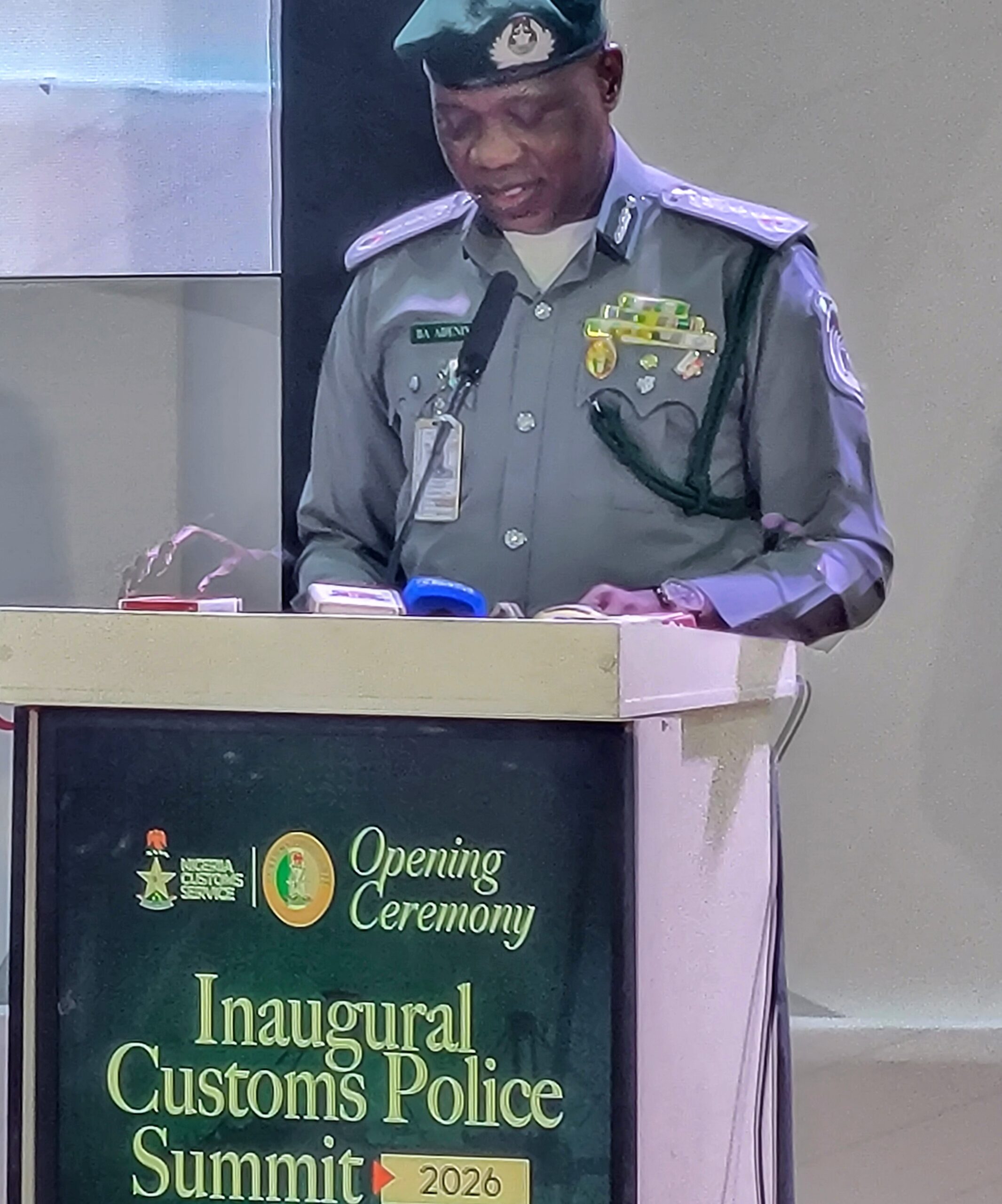
The Comptroller-General of Customs and Chairperson of the World Customs Organisation (WCO) Council, Bashir Adewale Adeniyi MFR, has warned officers of the Customs Police Unit (CPU) against abuse of powers, insisting that discipline, integrity and respect for the rule of law must remain the foundation of Customs policing.
Adeniyi gave the charge on Thursday at the Inaugural Customs Police Summit 2026 held at the NAF Conference Centre, Abuja, themed “Reimagining Customs Policing: Learning from the Past, Responding to the Present, and Preparing for the Future.”
The Summit, the first of its kind, brought together top officials from sister security agencies including the Nigerian Army, Nigerian Navy, Nigerian Security and Civil Defence Corps, Economic and Financial Crimes Commission (EFCC), National Drug Law Enforcement Agency (NDLEA) in solidarity with the Nigeria Customs Service.
Adeniyi, who traced the history of the CPU to its establishment in 2018 and formal inauguration in July 2019, said its core mandate remains to investigate erring personnel, prevent crime, ensure compliance and uphold the principle that “no officer is above the law.”
In his keynote, the Customs boss drew three lessons from history: that charity begins at home, that authority requires restraint, and that enforcement in isolation fails.
He noted that the Nigeria Customs Service Act 2023 provides the legal backbone for modern, intelligence-led operations, joint border management and mutual administrative assistance, but cautioned that powers under the Act must withstand public and judicial scrutiny.
Adeniyi described current threats facing Customs as increasingly sophisticated, ranging from smuggling of firearms, narcotics, counterfeit medicines and wildlife to illicit financial flows, often concealed within legitimate trade and enabled by digital platforms.
“Smarter, not harder enforcement” is the way forward, he said, citing deployment of the WCO SAFE Framework of Standards, Authorised Economic Operator (AEO) programme, the B’Odogwu customs management platform, and the INTERPOL Data Centre domiciled at the Customs Headquarters.
He outlined three strategic pillars for the future of Customs policing to include:
1. Consolidation: Translating operational practices into doctrine anchored in the NCS Act 2023 and the Revised Arusha Declaration on Integrity.
2. Collaboration: Deepening inter-agency cooperation with the Nigeria Police Force, Armed Forces and regulatory bodies.
3. Innovation: Leveraging AI, non-intrusive inspection technology, geospatial intelligence and cargo tracking, with human judgment at the centre.
The CGC called for a review of some original CPU responsibilities introduced in 2019, particularly the monitoring of containers in transit, in line with technological advancements that now make such oversight easier.
He listed four expected outcomes from the Summit: a CPU doctrine, joint operational protocols with sister agencies, guidelines for responsible use of AI and data, and recommendations on training, welfare and professionalism for CPU personnel.
Earlier, the Acting Provost Marshal, Customs Police Unit, Deputy Comptroller T.S. Sanusi, reiterated the Unit’s commitment to strengthening integrity and professional standards within the Service.
In a direct charge to personnel, Adeniyi said: “The Red Beret you wear carries the trust of Nigerians. Wear it with discipline, restraint and pride. Integrity remains the greatest badge.”
The Customs Police Summit continues with technical sessions on intelligence-led enforcement, border security and continental trade integration, aligning with the Service’s broader reform agenda under President Bola Tinubu’s administration.
Follow: @MigrationwatchLive on all platforms