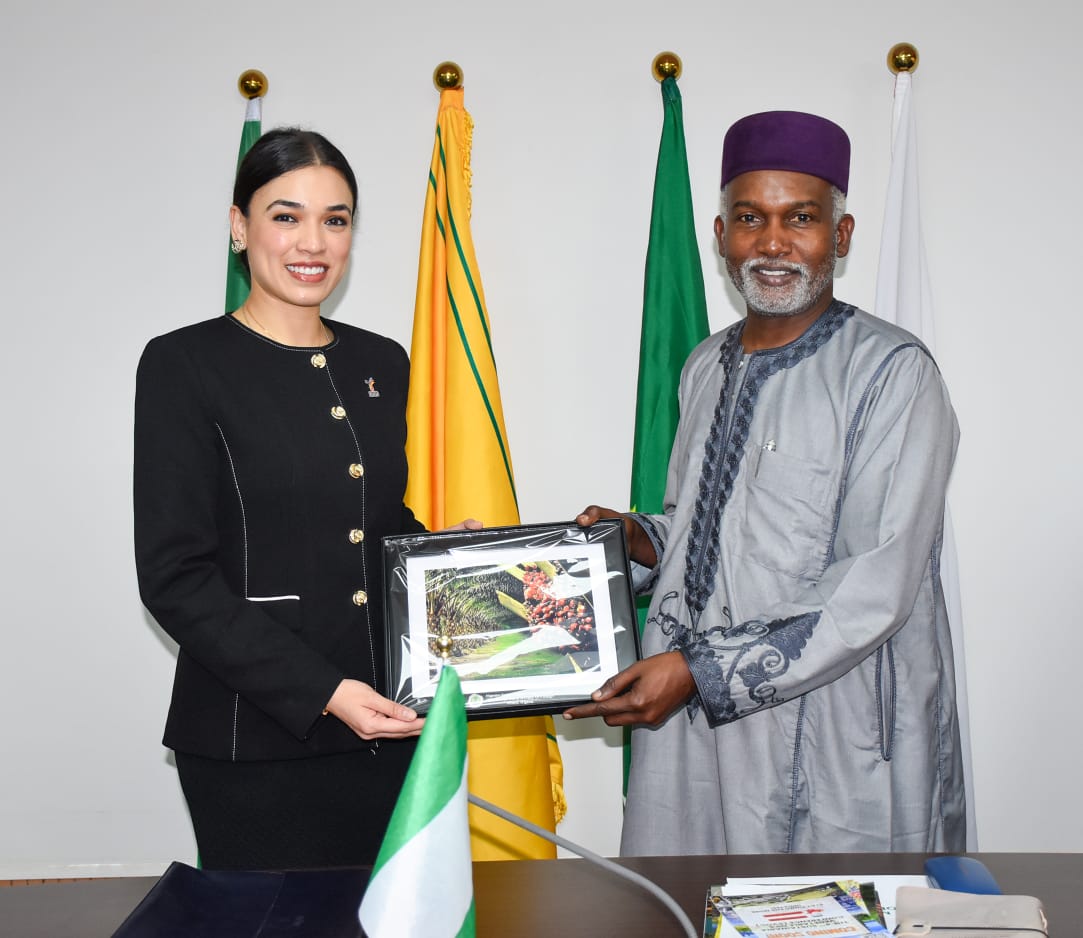
The Honourable Minister of Foreign Affairs, Ambassador Yusuf Maitama Tuggar, OON, on Friday 20th February 2026 met with the Secretary-General of the Council of Palm Oil Producing Countries (CPOPC), Izzana Salleh and members of the delegation, at the Ministry of Foreign Affairs, Abuja.
The engagement focused on Nigeria’s potential transition from observer status to full membership of the intergovernmental body.
Welcoming the delegation, the Minister eaffirmed Nigeria’s recognition of palm oil as a strategic commodity. He observed that palm oil historically underpinned industrial development in Europe and remains vital to food production, pharmaceuticals, cosmetics, and manufacturing.
He described criticisms of palm oil in certain global quarters as often inconsistent with historical realities and underscored the need for producing countries to assert evidence-based narratives.
The Minister also stated that for Nigeria, palm oil is not merely an agricultural product but a cornerstone of food security, rural livelihoods, and economic diversification. He noted that Nigeria currently produces approximately 1.4 million metric tonnes annually and consumes about 3 million tonnes, with ambitious plans to scale production significantly in the coming years.
Ambassador Tuggar described Nigeria’s potential membership of the CPOPC as a strategic step aligned with the administration’s priorities of food security, economic growth, and youth employment. He emphasized that joining the Council would strengthen Nigeria’s voice in global commodity diplomacy
Earlier in her opening remarks, Secretary-General Izzana Salleh, stated that the visit was both a courtesy call and a substantive policy engagement aimed at deepening institutional ties between Nigeria and the Council. She noted that Nigeria’s current observer status with the CPOPC expires at the end of the year and emphasized the importance of early consultations to facilitate a smooth transition to full membership.
Salleh described the CPOPC as an intergovernmental organization representing major palm oil producing countries, including Indonesia, Malaysia, Papua New Guinea, Honduras, and the Democratic Republic of Congo. She outlined the mandate of CPOPC to include playing a critical diplomatic and advocacy role in addressing trade barriers, regulatory challenges, and sustainability narratives affecting palm oil on the global stage, noting that the Council does not regulate production quotas like OPEC, it
She referenced the Council’s recent engagement with the European Union on the EU Deforestation Regulation (EUDR), highlighting how coordinated diplomacy and technical negotiations through a Joint Task Force helped articulate the interests of producing countries.
According to her, the Council serves as a unified voice for its members in multilateral platforms such as the United Nations, the World Bank, and other global forums. The Secretary-General further emphasised that global misconceptions and campaigns targeting palm oil necessitate science-based advocacy and coordinated diplomatic engagement to safeguard producer interests.
In a significant gesture of goodwill, the Secretary-General announced that the Council’s ministerial leadership had agreed to waive Nigeria’s membership fees for two years should it transition to full membership. She described this as a strategic move to enable Nigeria to integrate quickly into the Council’s multilateral advocacy framework and strengthen collective representation on global agricultural and trade matters.
Supporting this presentation, Mr. Tony Siew Lee, Director for Smallholders and Sustainability at CPOPC, elaborated on the Council’s training initiatives across member states, including capacity-building programmes in Africa.
He noted that palm oil accounts for approximately 60 percent of the global vegetable oil supply and plays a central role in food security, poverty alleviation, and rural development. He emphasized that empowering smallholders through good agricultural practices and sustainability compliance is critical to ensuring long-term sector resilience.